
ECONOMICS IN ACTION: How Does The RBI Control Inflation ?
Bilkul Bazaar | Sunday Special
By Rafat Quadri
The Powerful Connection Between Interest Rates, Money and the Prices We Pay
When vegetables become expensive, grocery bills rise and household budgets get tighter, one question often comes to mind: Who controls inflation in India? An important part of the answer lies with the Reserve Bank of India (RBI), the country’s central bank.
Inflation is not just an economic term discussed by financial experts. It affects almost every aspect of our daily lives, from buying groceries and filling fuel tanks to paying school fees, taking home loans and planning savings.
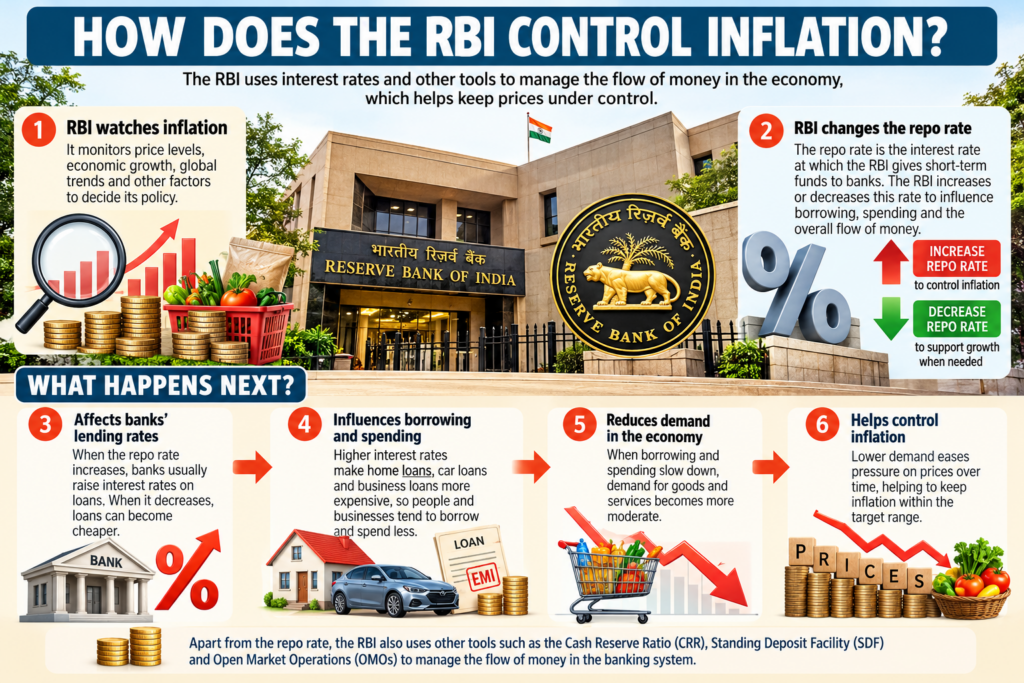
But how does the RBI actually control rising prices? Does it decide the price of petrol, vegetables or household essentials? Not exactly. Instead, it uses a powerful economic tool that influences how much money flows through the banking system and how expensive it is to borrow.
Let’s understand how this works.
What Is Inflation?
Inflation refers to a sustained increase in the general price level of goods and services over time. In simple words, when inflation rises, the same amount of money buys fewer things than before.
For example, imagine that a household could purchase its regular monthly grocery basket for ₹5,000 last year. If the prices of those items rise by 6 per cent, the same basket would cost approximately ₹5,300 this year.
The additional ₹300 represents the impact of inflation on that household’s expenses.
In India, the RBI primarily focuses on Consumer Price Index (CPI) inflation, which measures changes in the prices of goods and services commonly purchased by households.
Who Decides India’s Inflation Target?
India follows a flexible inflation-targeting framework.
The Central Government, in consultation with the RBI, sets the inflation target for a five-year period. For the period from April 1, 2026, to March 31, 2031, the target is:
• Main inflation target: 4 per cent.
• Upper tolerance limit: 6 per cent.
• Lower tolerance limit: 2 per cent.
This means the RBI’s monetary policy is designed to keep retail inflation around 4 per cent, while allowing it to move within the 2–6 per cent range.
The RBI is responsible for conducting monetary policy, while the Government also takes measures to address supply shortages and the prices of essential commodities.
The Main Weapon: The Repo Rate
One of the most important tools available to the RBI is the repo rate.
The repo rate is the interest rate at which the RBI provides short-term funds to eligible banks against approved securities under its liquidity framework.
In simple terms, it influences the cost at which banks obtain funds and, consequently, the interest rates they charge customers.
The RBI uses changes in the repo rate to influence borrowing, spending, saving and investment across the economy.
What Happens When the RBI Increases the Repo Rate?
Suppose inflation is rising rapidly and demand in the economy is growing faster than the available supply of goods and services.
The RBI may decide to increase the repo rate.
Here is how the process works:
1. Banks face a higher cost of borrowing from the RBI.
2. Banks may increase interest rates on loans, depending on their funding costs and lending benchmarks.
3. Home loans, car loans and business loans can become more expensive.
4. People and businesses may postpone some borrowing and spending.
5. Demand for goods and services may gradually moderate.
6. Reduced demand can ease pressure on prices over time.
For example, if someone is planning to purchase a house through a loan, an increase in lending rates may raise the EMI or the total interest payable, depending on the loan terms.
The person may decide to postpone the purchase or borrow a smaller amount.
When many households and businesses make similar decisions, overall demand in the economy can slow down.
This helps reduce inflationary pressure.
What Happens When the RBI Reduces the Repo Rate?
The reverse can happen when inflation is under control and economic growth needs support.
The RBI may reduce the repo rate.
This can encourage banks to lower their lending rates, making loans more affordable.
As borrowing becomes cheaper:
• People may be more willing to purchase homes and vehicles.
• Businesses may borrow to expand operations.
• Investment and consumption can increase.
• Economic activity may receive a boost.
However, if demand grows too quickly relative to supply, it can also create fresh inflationary pressure.
This is why the RBI has to balance price stability with economic growth.
How Does the RBI Control the Flow of Money?
Apart from the repo rate, the RBI uses several other instruments to manage liquidity, which refers to the availability of money in the banking system.
1. Cash Reserve Ratio (CRR)
Banks are required to maintain a prescribed percentage of their net demand and time liabilities as cash balances with the RBI.
If the CRR is increased, banks have less money available for lending. This can reduce liquidity and moderate credit growth.
If it is reduced, banks have more funds available for lending, subject to other constraints.
2. Standing Deposit Facility (SDF)
Through this facility, banks can deposit surplus funds with the RBI and earn interest.
It helps the RBI absorb excess liquidity from the banking system.
3. Open Market Operations (OMOs)
The RBI buys or sells government securities in the open market.
When it purchases securities, money generally flows into the banking system. When it sells securities, money is absorbed from the system.
These operations help manage liquidity and support the transmission of monetary policy.
Who Decides Whether Interest Rates Should Rise or Fall?
The decision is taken by the Monetary Policy Committee (MPC), a six-member committee established under the RBI Act.
The committee consists of:
• Three members from the RBI, including the RBI Governor.
• Three external members appointed by the Central Government.
The MPC assesses inflation trends, economic growth, global developments, food prices, fuel costs and other economic indicators before deciding the policy repo rate.
Its objective is to maintain price stability while keeping economic growth in mind.
Can the RBI Control the Prices of Vegetables, Petrol and Other Essentials?
This is where things become interesting.
The RBI does not directly decide the retail prices of onions, tomatoes, petrol, diesel or cooking oil.
Many price increases are caused by supply-side problems.
For example:
• Poor monsoon conditions can reduce agricultural production.
• Floods can damage crops and disrupt transportation.
• International crude oil price increases can make fuel more expensive.
• Global conflicts can disrupt supply chains.
• Shortages of essential commodities can push prices upwards.
Increasing interest rates cannot immediately produce more onions or reduce international crude oil prices.
Such problems often require government action, including improving supplies, releasing food stocks, adjusting import and export policies and addressing transportation bottlenecks.
This is why controlling inflation requires coordination between monetary policy, government policies and improvements in supply.
Why Does Inflation Control Take Time?
One common misunderstanding is that if the RBI increases the repo rate today, prices should start falling immediately.
That is not how monetary policy works.
Changes in interest rates gradually influence bank lending, household spending, business investment and overall demand.
These effects take time to reach the wider economy. In some cases, the transmission process can take several months or longer.
Moreover, controlling inflation does not necessarily mean that prices will return to their previous levels.
If inflation falls from 8 per cent to 4 per cent, it means prices are rising more slowly. It does not mean that goods and services have become 4 per cent cheaper.
This distinction is important for every consumer to understand.
The Balancing Act: Inflation Versus Growth
The RBI faces a challenging responsibility.
If it raises interest rates too aggressively, borrowing becomes expensive, consumption may slow and businesses may postpone expansion.
On the other hand, if interest rates remain too low when inflation is high, excessive demand and easy credit can add to price pressures.
The challenge is to maintain a balance where inflation remains under control without unnecessarily hurting economic growth.
The Bottom Line
The RBI may not decide how much a kilogram of tomatoes costs or what a litre of petrol should sell for, but its monetary policy influences the larger economic environment in which prices, loans, savings and investments move.
By adjusting interest rates, managing liquidity and guiding expectations, the central bank works to protect the purchasing power of money and maintain economic stability.
Inflation may begin in the marketplace, but controlling its broader impact requires careful decisions at the highest level of the country’s financial system.
ECONOMICS IN ACTION — Understanding the economic forces that shape our everyday lives, only on BilkulOnline.
Pingback: 90 pc of stolen assets now covered after security breach: Binance - Bilkul Bazaar