
HOW IT WORKS: THE STAPLER
The little machine that holds our papers together
Bilkul Bazaar Weekly Special
It sits on almost every office desk and is used countless times a day. Press it, and click!—a tiny piece of metal joins several sheets of paper together.
But how does this simple-looking device actually work? And who invented it?
From Royalty to the Office Desk
The history of the stapler goes back to 18th-century France. One of the earliest known stapling devices was reportedly made for King Louis XV. It used specially made metal fasteners bearing the royal insignia.
The modern stapler, however, developed much later. During the 19th century, inventors created different machines for fastening paper as offices and paperwork expanded.
In 1866, American inventor George W. McGill received a patent for a bendable paper fastener. Further inventions and improvements eventually produced the familiar desktop stapler we use today.
Why Was It Invented?
The need was simple: to join sheets of paper quickly and securely.
Before staplers became common, documents could be tied with string, glued, pinned or otherwise fastened. Stapling offered a much faster and cleaner solution.
So, How Does a Stapler Work?
A stapler is essentially a small lever-operated machine.
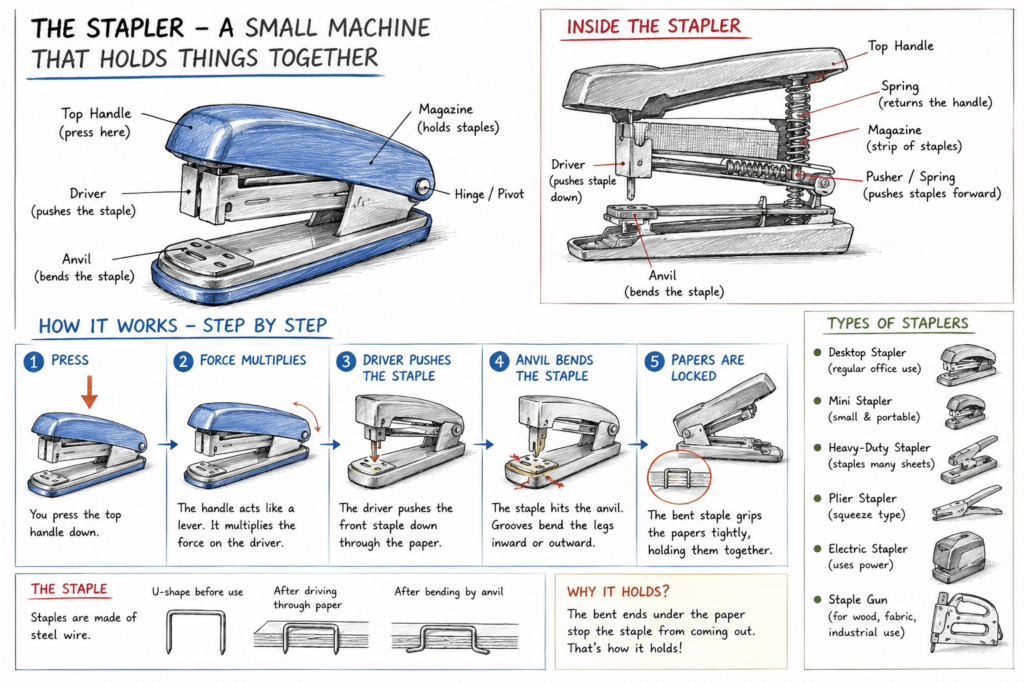
Its main parts include:
- Handle: The part you press.
- Magazine: Holds the strip of staples.
- Driver: Pushes the staple out.
- Spring/pusher: Moves the next staple into position.
- Hinge: Acts as the pivot.
- Anvil: The metal plate underneath the paper that bends the staple.
Step 1: Press the Handle
When you press the top, the handle moves around its hinge.
Step 2: Force Is Concentrated
The lever arrangement increases the force produced by your hand and directs it towards the front of the stapler.
Step 3: The Driver Pushes the Staple
A small metal blade called the driver pushes the first staple down through the sheets of paper.
Step 4: The Anvil Bends It
The staple reaches the metal plate underneath. Special grooves in the anvil bend the two legs of the staple.
Step 5: The Papers Are Locked
The bent staple grips the sheets and holds them together.
So, in simple terms:
Press → Push → Pierce → Bend → Hold
What Are Staples Made Of?
Most ordinary staples are made from steel wire because steel is strong, inexpensive and can be shaped easily.
Some staples are galvanised or coated to protect them from rust. Special staples may be made from stainless steel, aluminium or other materials.
The stapler itself may contain a mixture of steel, plastic, springs and rubber or soft-plastic grips.
How Many Types of Staplers Are There?
There is no single official number, but staplers come in many forms for different jobs.
1. Desktop stapler: The standard office variety.
2. Mini stapler: Small and portable, usually used for a few sheets.
3. Heavy-duty stapler: Designed for large stacks of paper.
4. Long-reach stapler: Useful for booklets and documents where stapling is required farther from the edge.
5. Plier stapler: Operated by squeezing two handles; commonly used in packaging.
6. Electric stapler: Uses a motor to drive the staple.
7. Pneumatic stapler: Uses compressed air and is common in industrial applications.
8. Saddle stapler: Designed to staple the centre fold of booklets.
9. Staple gun: A more powerful version used for wood, furniture, upholstery, packaging and construction.
Why Is a Staple U-Shaped?
A staple begins as a short piece of metal wire bent into a U shape.
Its two legs pass through the material while the top portion remains above it. When the legs are bent underneath, they form a mechanical lock.
This is why a tiny piece of steel can hold several sheets together so effectively.
Why Do Staplers Sometimes Jam?
Stapler jams usually happen when:
- The wrong staple size is used
- Two staples enter the mechanism together
- A staple is bent or damaged
- Too many sheets are being stapled
- The driver becomes misaligned
- The mechanism becomes worn
Using the correct staple size for the stapler can prevent many jams.
DID YOU KNOW?
● The stapler is basically a lever.
Its handle uses mechanical advantage to turn a small movement of your hand into enough force to drive a staple through paper.
● The anvil does an important job.
The staple doesn’t simply pass through the paper. The grooves underneath bend its legs and lock it in place.
● Some staplers allow two types of fastening.
Certain models have a rotating anvil that allows staples to bend inward for a firm hold or outward for easier removal.
● Staplers aren’t just for paper.
Industrial staplers are used in furniture, upholstery, packaging, bookbinding and construction.
● A tiny piece of steel can do a big job.
The strength of a staple comes not only from the metal but also from its shape and the way it is bent.
From King Louis XV to Every Office
The stapler has travelled a long way—from an expensive fastening device associated with royalty to an inexpensive tool found in homes, schools and offices around the world.
Its design may look simple, but inside it is a neat combination of leverage, springs, precision and mechanical force.
So the next time you hear that familiar click, remember: you’re not just fastening paper. You’re using a tiny machine that turns a simple push of your hand into a strong mechanical lock.