
The Business Behind …
The Business Behind Online Food Delivery
Bilkul Bazaar | Sunday Special
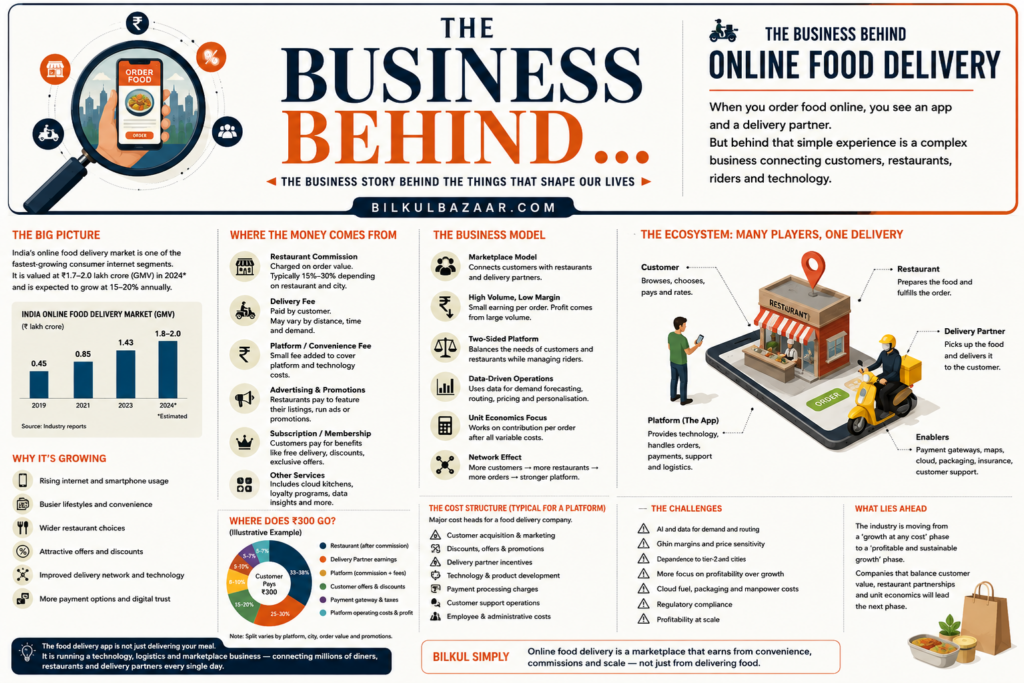
The central question:
When you order a ₹300 meal online, who actually gets your money—and how does the food-delivery company make money?
The story could follow this chain:
Customer → Food Delivery App → Restaurant → Delivery Partner → Customer
But underneath that simple journey is a much bigger business model.
1. The Customer
You open the app, choose a restaurant, order food and pay.
Your ₹300 order may actually become ₹350–₹400 after delivery fees, platform fees, taxes and other charges.
2. The Restaurant
The restaurant prepares the food and receives the order through the platform.
But it doesn’t necessarily receive the entire amount you paid.
The platform may charge the restaurant a commission, depending on its agreement.
3. The Food-Delivery Platform
This is where the interesting business begins.
The platform can earn from several sources:
- Restaurant commissions
- Delivery charges
- Platform/convenience fees
- Advertising and promoted listings
- Subscription/membership programmes
- Other services offered to restaurants
So the app isn’t simply “delivering food.”
It is operating a technology + logistics + advertising marketplace.
4. The Delivery Partner
The delivery partner collects the food from the restaurant and takes it to the customer.
The platform has to balance:
Delivery earnings + incentives + fuel/time costs + order density
The economics become much better when one delivery partner can complete more orders efficiently.
5. The Hidden Cost: Getting the Customer
This is one of the most important parts of the story.
Food-delivery companies spend heavily to attract and retain customers through:
- Discounts
- Promotional offers
- Advertising
- Membership benefits
- Restaurant promotions
So revenue is not the same as profit.
The ₹300 Order
We could make this the centrepiece of the article with a simple illustrative example:
Customer pays: ₹300 for food
↓
Restaurant: receives its contracted share after applicable platform charges
↓
Platform: earns commissions/fees and may incur delivery, technology, marketing and payment-related costs
↓
Delivery partner: receives delivery earnings/incentives
↓
Government: receives applicable taxes
The exact split varies by platform, restaurant agreement, order value and location, so we should present our numbers as an illustration rather than claim a universal percentage.
And the big question:
If millions of orders are placed, why is making money still difficult?
Because food delivery has a lot of costs.
Customer acquisition + discounts + delivery + technology + employees + payment costs + customer support + incentives + corporate expenses
The platform needs sufficient order volume and contribution per order to make the model work.
The Bilkul Bazaar takeaway
A food-delivery app is not a restaurant. It is a marketplace and logistics business that connects three sides—customers, restaurants and delivery partners—and tries to earn from the transactions happening between them.