
How it Works : Sand to Glass
From Sand to Glass: The Making of a Transparent Wonder
Bilkul Bazaar | Weekly Special
Ever wondered how ordinary sand becomes the transparent glass in our windows, bottles, mirrors and drinking glasses?
The answer lies in a fascinating process that combines natural materials, extreme heat and precise engineering. Let’s find out how it happens.
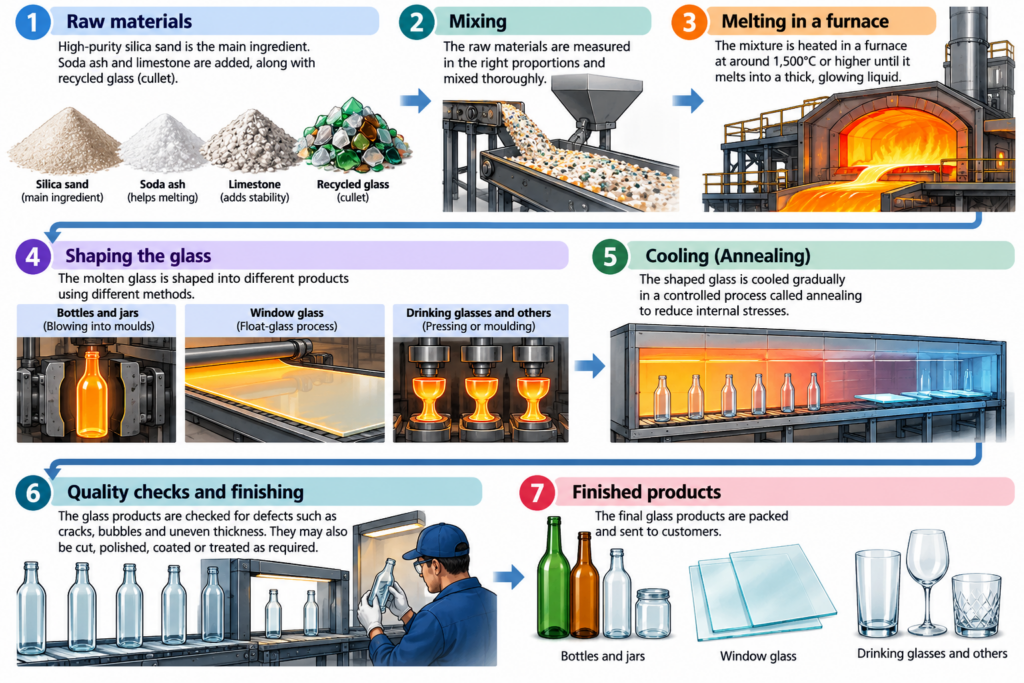
1. It Begins with Sand
The main raw material used in most common glass is silica sand. But not every kind of sand is suitable. Manufacturers need sand with a high silica content and very few impurities.
Other materials are added to make the glass easier to manufacture and improve its properties. Soda ash helps lower the temperature needed to melt the mixture, while limestone makes the finished glass more stable and durable.
2. Mixing the Ingredients
The selected raw materials are measured carefully and mixed in specific proportions.
Recycled glass, known as cullet, can also be added to the mixture. Using cullet helps reduce the energy required for melting and makes productive use of discarded glass.
The mixture is now ready for the furnace.
3. The Furnace: Where the Magic Happens
The mixture enters a furnace that can reach temperatures of around 1,500°C or even higher, depending on the process.
At this extreme temperature, the ingredients melt and combine to form a thick, glowing liquid.
The molten glass must be heated and mixed under carefully controlled conditions to remove bubbles and achieve the required quality.
What began as grains of sand has now become a hot, flowing material that can be shaped into different products.
4. Giving Glass Its Shape
This is where the manufacturing process becomes especially interesting. Different products require different methods.
- Bottles and jars: Molten glass is cut into measured portions, placed into moulds and blown into shape.
- Window glass: In the float-glass process, molten glass flows onto a bath of molten tin. It spreads out into a smooth, flat sheet.
- Drinking glasses and other products: Special moulding and pressing methods are used to create the required shapes.
The same basic material can therefore become a bottle, a windowpane or a drinking glass.
5. Cooling It Without Breaking It
Glass cannot simply be made and left to cool quickly. Sudden cooling can create internal stresses that may cause it to crack or break.
The newly formed glass passes through a controlled cooling process called annealing. Its temperature is lowered gradually so that internal stresses are reduced.
Some products, such as tempered glass, undergo additional heat-treatment processes to improve their strength and alter how they break.
6. Quality Checks and Packaging
Before reaching the market, glass products are checked for defects such as cracks, bubbles, uneven thickness and incorrect dimensions.
Products that meet the required standards are packed and sent to distributors, manufacturers, retailers or directly to customers.
For flat glass, additional steps such as cutting, polishing, coating or laminating may be carried out depending on its intended use.
THE BUSINESS BEHIND THE GLASS
Making glass is not just about melting sand. It is also a business that depends on energy, technology, logistics and large-scale production.
The major costs include:
- Raw materials and their transportation
- Fuel and electricity for high-temperature furnaces
- Machinery, moulds and maintenance
- Workers, quality control and packaging
- Transportation of finished products, which can be heavy and fragile
Glass manufacturing often requires substantial investment in furnaces and production equipment. Because furnaces operate continuously for long periods, keeping them productive and energy-efficient is important.
Manufacturers also face pressure to reduce energy consumption, use more recycled glass and control emissions.
WHY RECYCLED GLASS MATTERS
Glass has an important advantage: it can be recycled repeatedly without losing its basic material quality, provided it is collected and processed correctly.
Recycled glass can reduce the need for some virgin raw materials and lower melting-energy requirements. However, effective recycling depends on proper collection, sorting and removal of contaminants.
This makes waste collection an important part of the glass industry’s supply chain.
The next time you look through a window or pick up a glass bottle, remember that it began with carefully selected raw materials, passed through a furnace hotter than 1,500°C, and was shaped and cooled under controlled conditions.
Sand becomes glass through science. Glass becomes a business through technology, scale and efficiency.
That is how one of the world’s most useful materials is made — Bilkul Simply!
Note: We seek Sponsors for this column. Please connect with us at infobilkul@gmail.com