
THE BUSINESS BEHIND… EVERY LITRE OF PETROL
Bilkul Bazaar | Sunday Special
From crude oil imports to the fuel pump, discover how petrol pricing works and where the money goes.
Every time a customer fills a motorcycle or car with petrol, a complex business operation is at work. Behind every litre lies an international oil market, large refineries, transportation networks, government taxes and a chain of businesses that brings fuel to the consumer.
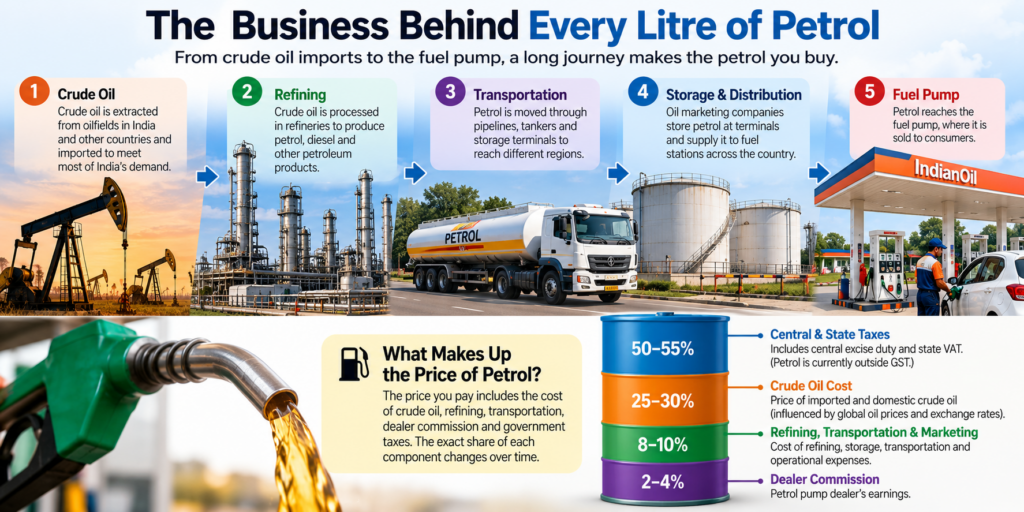
But how is the price of petrol determined, and who earns money from every litre sold?
1. It Begins With Crude Oil
Petrol starts its journey as crude oil, a naturally occurring resource extracted from oilfields in India and other countries.
India imports a substantial share of its crude oil requirements, making domestic fuel economics sensitive to international crude prices, exchange rates and geopolitical developments.
Oil companies purchase crude oil and transport it to refineries, where it is processed into petrol, diesel, aviation turbine fuel and other petroleum products.
The cost of crude oil is one of the major factors influencing petrol prices, although the final retail price also depends on several domestic factors.
2. Refineries Turn Crude Oil Into Petrol
Crude oil cannot be used directly as petrol in ordinary vehicles. It must undergo refining, which involves separating and processing hydrocarbons into usable fuels.
Refineries require substantial investment in equipment, technology, energy, storage and skilled personnel.
The cost of refining, together with the cost of crude oil, influences the value of petrol supplied to the domestic market. Refinery operations also produce other fuels and petroleum products, so costs and revenues are spread across a range of outputs.
3. Transportation Adds Another Layer
Once petrol is produced, it must be transported to storage terminals and fuel stations.
Pipelines, tankers, depots and road tankers form an extensive distribution network. Companies must also manage storage, quality checks, safety systems and logistics.
These operations add costs to the fuel supply chain before petrol reaches the customer.
4. Where Do Government Taxes Come In?
Taxes are an important component of the retail petrol price in India.
Unlike many goods covered by the Goods and Services Tax (GST), petrol for retail motor-fuel use is currently outside the GST system. Central excise duty and state-level taxes, including VAT, play important roles in determining the price consumers pay.
State taxes vary, which is one reason petrol prices differ between states and cities.
The retail price can also reflect deal
Pingback: India's office leasing stays strong in Q3; BFSI, Flex spaces gain ground: Report - Bilkul Bazaar