Beyond labs, ANRF bets big on real-world research impact
Bilkul Bazaar
Thiruvananthapuram | 03 May 2026
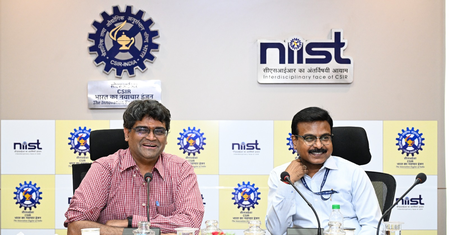
Shivkumar Kalyanaraman, Chief Executive Officer of the Anusandhan National Research Foundation (ANRF), has underscored a decisive shift towards outcome-oriented scientific research during his visit to the CSIR National Institute for Interdisciplinary Science and Technology (CSIR–NIIST), here. Interacting with scientists at the Thiruvananthapuram-based institute, Kalyanaraman stressed that India’s evolving research ecosystem must prioritise measurable societal and national impact over purely academic outcomes.
He noted that ANRF is actively seeking to fund projects capable of scaling beyond laboratories into field-level implementation, signalling a clear pivot towards translational science. With a career spanning global technology and research institutions, including leadership roles at Microsoft, GE Power, and IBM Research, Kalyanaraman highlighted the importance of integrating industry, academia and government efforts. He encouraged researchers to pursue ambitious, mission-driven proposals, asserting that funding constraints would not be a barrier for projects demonstrating tangible impact.
The visit comes at a crucial juncture as ANRF, a newly established statutory body, begins operationalising large-scale funding programmes, including Research, Development and Innovation (RDI) initiatives. The foundation aims to catalyse collaboration across sectors while strengthening India’s innovation pipeline. At CSIR–NIIST, Kalyanaraman reviewed a range of interdisciplinary research programmes. These included work in Carbon Capture, Utilisation and Storage (CCUS), which focuses on carbon management and climate mitigation, as well as advancements in sustainable food processing technologies.
He also visited the institute’s Designer Rice programme, which is developing nutritionally enhanced rice varieties with improved glycaemic response, an effort aligned with addressing public health and food security challenges. C. Anandharamakrishnan, Director of CSIR–NIIST, said the interaction provided critical insights into national research priorities and opened avenues for collaborative, interdisciplinary work aligned with mission-oriented goals. The visit reflects a broader policy direction in India’s science administration, one that seeks to bridge the gap between laboratory innovation and real-world application, positioning research as a key driver of economic growth and societal transformation.