
How It Works
Bilkul Bazaar Weekly Special
How Airbags Save Lives: The Invisible Safety Hero Inside Your Car
A Split-Second That Can Change Everything
Imagine driving home from work when another vehicle suddenly appears in front of you. You slam on the brakes, but a collision is unavoidable. In less than the blink of an eye, a soft cushion bursts out from your steering wheel or dashboard, protecting you from hitting hard surfaces inside the car.
That life-saving cushion is an airbag—one of the most important safety inventions in modern automobiles.
Most of us know airbags are there, but very few know how they work or how quickly they save lives. Let’s take a look inside this remarkable technology.
What Is an Airbag?
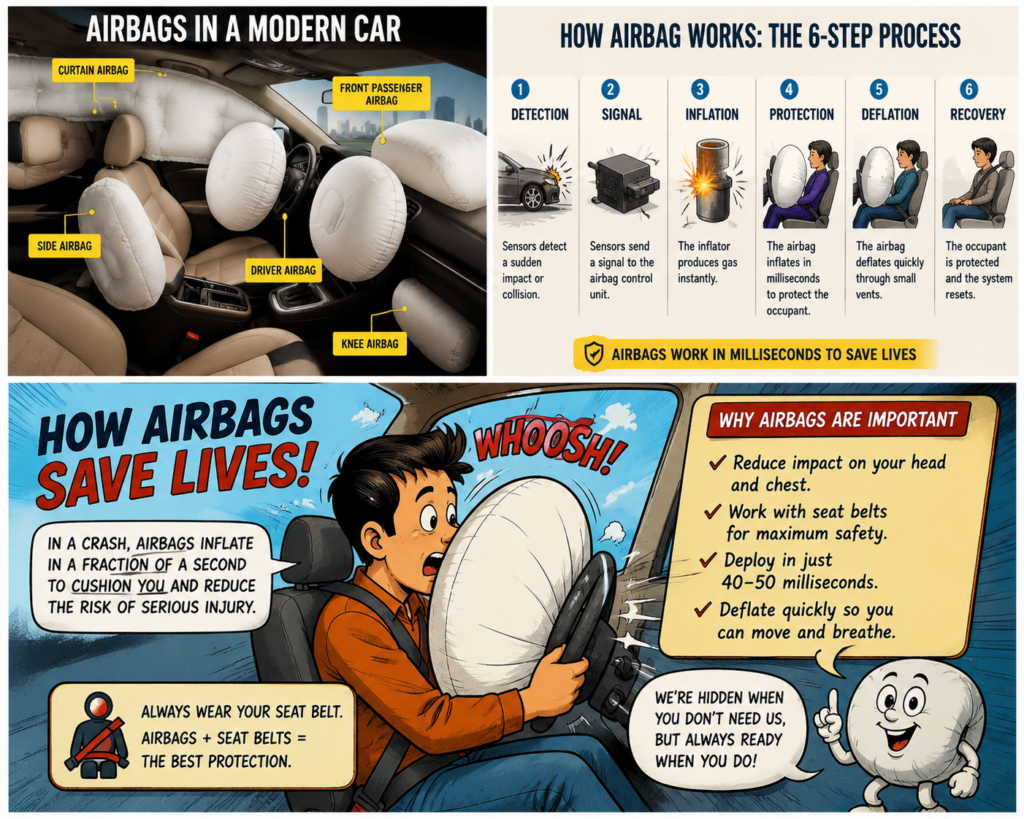
An airbag is a safety device hidden inside different parts of a vehicle. It inflates instantly during a serious crash, creating a cushion between the passengers and hard surfaces such as the steering wheel, dashboard, doors or windows.
Contrary to its name, an airbag is not filled with ordinary air. It is filled with gas produced in a fraction of a second and deflates almost immediately after protecting the passenger.
Its job is simple: reduce the force of impact on the human body.
Where Are Airbags Located?
Today’s cars may have several airbags placed in different locations.
Some of the most common are:
- Driver airbag in the steering wheel
- Front passenger airbag in the dashboard
- Side airbags inside the seats
- Curtain airbags along the roof
- Knee airbags below the dashboard
- Rear-seat airbags in some premium vehicles
Many modern cars now come with six or more airbags as standard.
How Does an Airbag Know When to Open?
The secret lies in tiny electronic sensors placed around the vehicle.
These sensors constantly monitor:
- Vehicle speed
- Sudden deceleration
- Direction of impact
- Crash severity
When they detect a serious collision, they send an electrical signal to the airbag control unit.
The control unit instantly decides whether the crash is severe enough to deploy the airbags.
This entire decision happens in just a few milliseconds.
What Happens During a Crash?
The process is amazingly fast.
Step 1: Sensors detect a strong impact.
Step 2: The airbag control unit sends an electrical signal.
Step 3: A small inflator rapidly produces harmless gas.
Step 4: The folded airbag inflates almost instantly.
Step 5: Your head and chest strike the soft cushion instead of hard metal or glass.
Step 6: Tiny holes in the bag allow the gas to escape immediately, preventing the passenger from bouncing back.
The entire inflation and deflation process takes only about 40 to 50 milliseconds—faster than the blink of a human eye.
Why Is Speed So Important?
During a collision, a moving vehicle may stop suddenly, but the people inside continue moving forward because of momentum.
Without an airbag, a person’s head or chest could strike the steering wheel, dashboard or windshield with tremendous force.
The airbag spreads that force over a larger area of the body and slows the movement just enough to reduce serious injuries.
Airbags and Seat Belts: A Perfect Team
Many people think airbags can replace seat belts.
They cannot.
Airbags are designed to work with seat belts, not instead of them.
The seat belt keeps you in the correct position, while the airbag cushions the impact.
Without wearing a seat belt, a person may move too far forward before the airbag inflates, increasing the risk of injury.
Safety experts around the world agree that the combination of a seat belt and an airbag provides the best protection.
Interesting Facts You May Not Know
Airbags Work Faster Than You Can Blink
A human blink takes around 100–150 milliseconds. Most airbags inflate in less than 50 milliseconds.
The Airbag Doesn’t Stay Inflated
It begins deflating almost immediately after deployment so that passengers can move and breathe normally.
Modern Cars Can Have Up to 10 Airbags
Luxury vehicles may include front, side, curtain, knee and even centre airbags between the driver and front passenger.
Airbags Are Used Beyond Cars
Airbag technology is also found in some motorcycles, aircraft safety systems and even spacecraft landing equipment in specialized forms.
Child Safety Matters
Children under a certain age or height are safest in the rear seat. Rear-facing child seats should never be placed in front of an active passenger airbag because the force of deployment can seriously injure a child.
Can an Airbag Cause Injury?
Yes—but usually only minor injuries compared to what could happen without one.
Because airbags deploy with great force, some people may experience:
- Minor burns
- Bruises
- Small cuts
- Facial irritation
These injuries are generally far less severe than the head, chest or spinal injuries an airbag helps prevent.
Do Airbags Need Maintenance?
Airbags are designed to last for many years without routine servicing.
However, if the airbag warning light remains on while driving, it may indicate a fault in the system.
In that case, the vehicle should be inspected by an authorised service centre as soon as possible.
After an airbag deploys in a crash, it must be replaced along with related components before the vehicle is driven again.
The Future of Airbag Technology
Car manufacturers continue to improve airbag systems.
Newer technologies include:
- Smart airbags that adjust deployment based on crash severity.
- Sensors that detect passenger size and seating position.
- Centre airbags that reduce injuries between front-seat occupants.
- External airbags being developed to help protect pedestrians and reduce crash impact.
The goal is simple: make every journey safer.
Why This Technology Matters
Every year, millions of people around the world survive road accidents because of airbags working together with seat belts and other vehicle safety systems.
The next time you sit behind the steering wheel, remember that one of your car’s greatest safety features is completely hidden from view—always ready to protect you in the critical fraction of a second when it matters most.
Quick Facts
- Airbags deploy in about 40–50 milliseconds.
- They are activated by crash sensors and a control unit.
- They inflate with gas, not ordinary air.
- They are designed to work with seat belts, not replace them.
- Modern vehicles may have 6 to 10 airbags.
- After deployment, airbags must be replaced.
Did You Know?
The first commercial airbags appeared in cars during the 1970s, but they became widely used only after improvements in electronic crash sensors and stricter vehicle safety regulations. Today, airbags are considered one of the greatest advances in automotive safety and have helped save countless lives worldwide.
(images AI)