How It Works
Bilkul Bazaar Special Weekly Column
Welcome to ‘How It Works’
Every day, we use countless products, technologies and systems without giving much thought to the fascinating science and engineering behind them. Yet each invention has a story, a principle and a mechanism that makes it work.
How It Works is BilkulBazaar.com’s new weekly column that unravels the mysteries behind everyday objects, groundbreaking technologies and remarkable innovations. From household gadgets and medical devices to transportation, space technology, artificial intelligence and scientific discoveries, we’ll explain how things work in simple, engaging language—without complicated jargon.
Each week, we’ll take one topic, break it down step by step, share interesting facts, bust common myths and reveal the science that powers our world.
Because understanding how things work doesn’t just satisfy curiosity—it inspires innovation, informed decisions and a deeper appreciation for the incredible ideas shaping our lives.
Join us every week as we explore one fascinating topic at a time and discover that every great invention has an even greater story behind it.
How It Works : GPS
How GPS Knows Exactly Where You Are
“You may not know the road, but your phone almost always does.”
Whether you’re navigating through city traffic, tracking a food delivery, hailing a cab, or finding a lost smartphone, one invisible technology quietly guides millions of people every second: the Global Positioning System (GPS).
What’s remarkable is that GPS doesn’t rely on mobile towers or the internet to determine your location. Instead, it listens to signals travelling from space at the speed of light.
The Journey Begins… 20,000 Kilometres Above Earth
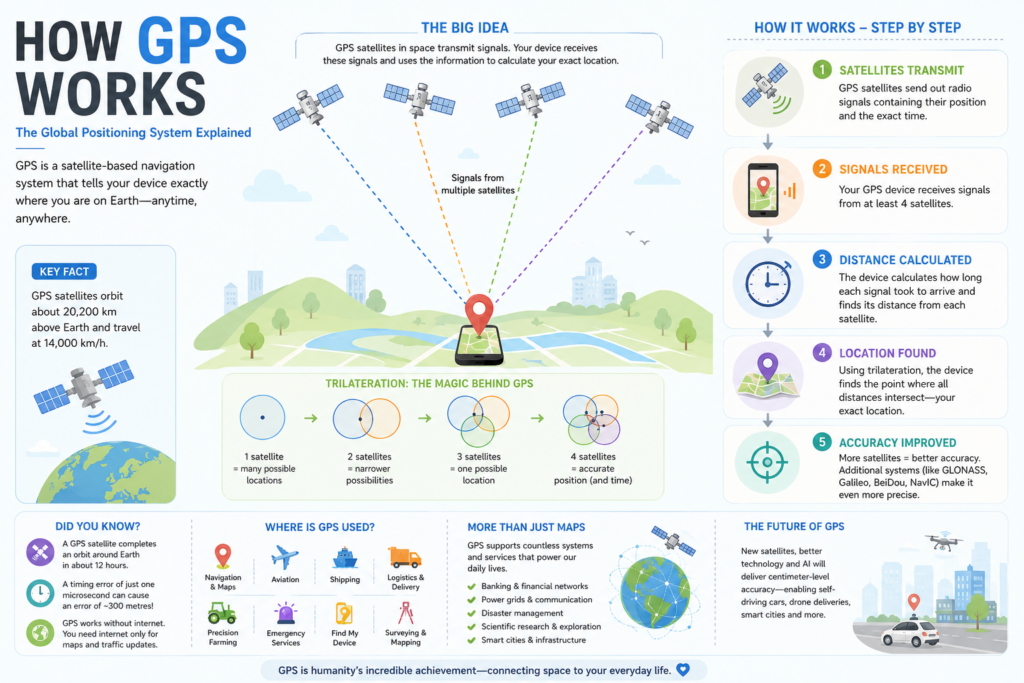
Orbiting around Earth are dozens of GPS satellites, each travelling at nearly 14,000 km/h. They circle the planet twice a day, continuously broadcasting two simple pieces of information:
- Their exact position in space.
- The precise time the signal was sent.
Each satellite carries highly accurate atomic clocks that lose only a tiny fraction of a second over millions of years. This extraordinary accuracy is the secret behind GPS.
Your Phone Doesn’t Ask—It Listens
Many people think their smartphone contacts a satellite asking, “Where am I?”
In reality, the opposite happens.
Satellites constantly transmit radio signals, and your GPS receiver simply listens. By measuring how long each signal takes to arrive, your device calculates its distance from each satellite.
Since radio waves travel at the speed of light, even a timing error of one-millionth of a second can shift your calculated position by hundreds of metres. That’s why precision timing is everything.
The Magic of Trilateration
Imagine standing somewhere inside a city.
If you know you’re exactly 10 kilometres from one landmark, you could be anywhere along a circle with a 10-kilometre radius.
Now add a second landmark. The circles intersect at two possible locations.
Add a third landmark, and only one position matches all three distances.
This method is called trilateration, and it’s how GPS determines your location.
A fourth satellite is usually used to correct tiny timing errors in your phone’s internal clock, making the position far more accurate.
Why GPS Sometimes Gets Confused
Ever noticed your navigation arrow spinning or showing you’re on the wrong street?
GPS signals are incredibly weak by the time they reach Earth. Dense skyscrapers, tunnels, mountains, thick forests, and even severe weather can interfere with reception.
In cities filled with tall buildings, signals often bounce off glass and concrete before reaching your phone. This “multipath effect” can briefly fool the receiver into thinking you’re somewhere else.
That’s why your location often becomes more accurate after a few seconds in an open area.
GPS Isn’t Alone Anymore
Although people commonly say “GPS,” modern smartphones usually use several satellite navigation systems simultaneously:
- GPS (United States)
- GLONASS (Russia)
- Galileo (European Union)
- BeiDou (China)
- NavIC (India)
By combining signals from multiple systems, today’s smartphones often achieve much better accuracy than older GPS-only devices.
More Than Just Maps
GPS quietly powers much of modern life.
It helps aircraft navigate safely, synchronises banking networks, enables emergency responders to locate callers, guides ships across oceans, supports precision farming, tracks wildlife, manages logistics fleets, and even helps scientists monitor earthquakes and changes in Earth’s surface.
Without GPS, many of the digital services we use daily would become slower, less reliable, or impossible.
The Future of Positioning
The next generation of satellite navigation promises even greater precision.
With improved satellite technology, better receivers, and artificial intelligence correcting signal errors, future navigation could pinpoint locations within a few centimetres. This level of accuracy will be crucial for autonomous vehicles, delivery drones, smart cities, and advanced robotics.
Did You Know?
- A GPS satellite completes an orbit around Earth in about 12 hours.
- GPS works without an internet connection. Your phone needs the internet only to download maps and traffic updates.
- Light travels about 300,000 kilometres every second, which is why GPS depends on ultra-precise timing.
- A small timing error of just one microsecond can result in a location error of nearly 300 metres.
- Your smartphone can often detect signals from 20–30 satellites at the same time.
Bilkul Takeaway
GPS is one of humanity’s most remarkable engineering achievements. Every time your navigation app tells you to “turn left,” it is solving an astonishing mathematical puzzle using signals from satellites thousands of kilometres above Earth—all in less than a second.
The next time your phone pinpoints your location, remember: it isn’t guessing. It’s measuring time with extraordinary precision and turning it into a map of the world around you. (Designed with AI)