
BUSINESS TERMS — BILKUL SIMPLY
Making Business Jargon Bilkul Simple
Business has a language of its own. Words like Revenue, Profit, Margin, Break-even and Working Capital appear everywhere—in business news, company reports, IPO documents and everyday conversations. But what do they actually mean?
That is where BUSINESS TERMS — BILKUL SIMPLY comes in.
A new weekly column from Bilkul Bazaar, this is our simple attempt to make commonly used business terms easy to understand—without complicated definitions, technical language or financial jargon.
Every week, we will pick five important business terms, explain each one in simple words, and give you a quick, practical example of how it works in the real world.
Whether you are a student, entrepreneur, investor, professional—or simply someone who wants to understand business news better—this column is designed to help you speak and understand the language of business with greater confidence.
Because business terms need not be complicated.
Know the Term. Understand the Business.
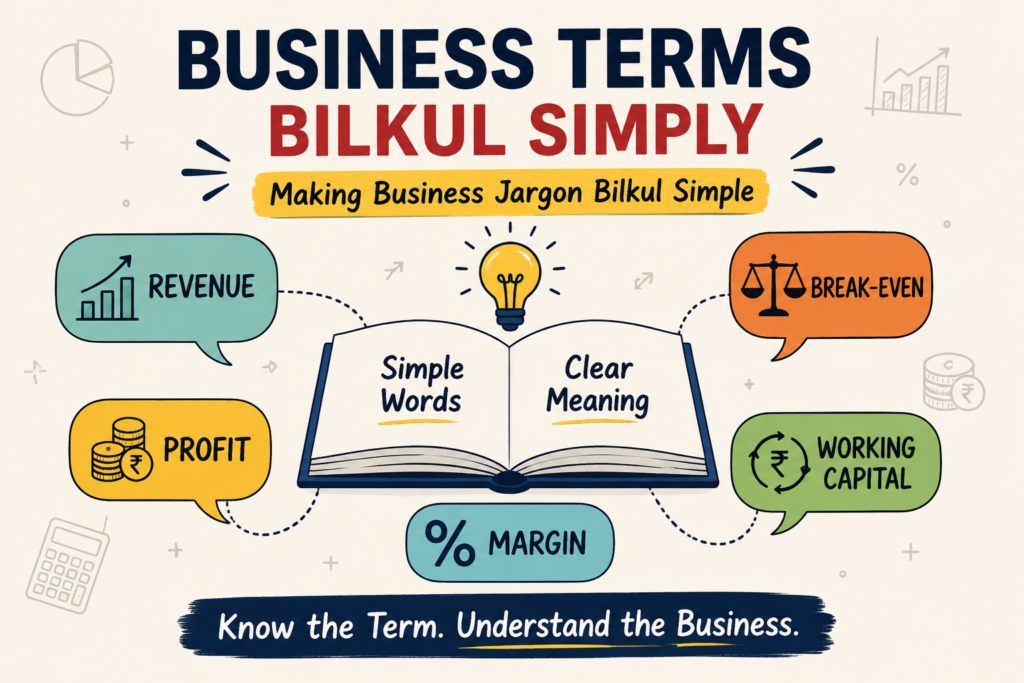
- Revenue — The total money a business earns from selling its products or services, before expenses are deducted.
Example: If a shop sells ₹10 lakh worth of goods in a year, its revenue is ₹10 lakh. - Profit — The money left after a business pays all its expenses.
Example: If a business earns ₹10 lakh and spends ₹8 lakh, its profit is ₹2 lakh. - Margin — The percentage of revenue that remains as profit after relevant costs.
Example: If a company earns ₹100 and keeps ₹20 as profit, its profit margin is 20%. - Break-even — The point at which a business’s total income equals its total costs, meaning there is neither profit nor loss.
Example: A café that needs to sell 500 cups a day to cover all its costs reaches break-even at 500 cups. - Working Capital — The money a business needs to manage its day-to-day operations, such as buying stock and paying suppliers and employees.
Example: A retailer needs working capital to buy new inventory before it sells the existing stock.