Why Your Grocery Bill Is Rising — The Economics of Inflation
Bilkul Bazaar | Sunday Special
By Rafat Quadri
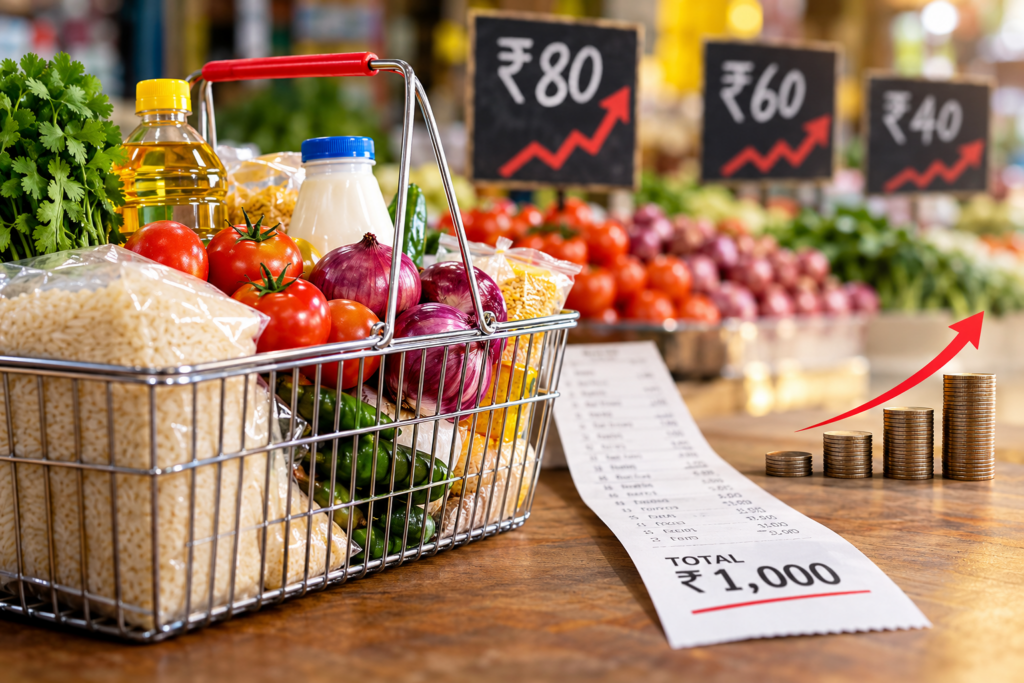
Why does the same ₹1,000 buy fewer groceries than it did a year ago? The answer lies in one of the most important forces shaping our everyday lives: inflation.
You walk into your neighbourhood grocery shop with ₹1,000. You buy rice, cooking oil, vegetables, milk and a few household essentials. But when you look into your shopping bag, something feels different. There seems to be less than what the same amount of money bought earlier.
Your money hasn’t changed. Its purchasing power has.
This is inflation in action.
What Exactly Is Inflation?
Inflation refers to a sustained increase in the general price level of goods and services over time. As prices rise, every rupee buys a little less than it did before.
Imagine a household spending ₹10,000 every month on groceries. If the prices of its usual purchases rise by 6%, the family would need ₹10,600 to buy the same basket of goods. That means an additional ₹600 every month, or ₹7,200 over a year.
For families already managing tight budgets, this additional expense can mean cutting back on entertainment, eating out, shopping for clothes or even other essential purchases.
The important point is that inflation does not necessarily make us poorer in terms of the number of rupees we possess. It reduces what those rupees can buy.
Why Do Grocery Prices Rise?
Food prices are influenced by several economic forces, and the journey from a farm to your kitchen offers a useful way to understand them.
1. Demand and Supply
When demand for a product exceeds the available supply, prices tend to rise. Consider tomatoes. If heavy rainfall damages crops, fewer tomatoes reach the market. Consumers still need them, but the supply has fallen. The result can be a sharp increase in prices.
On the other hand, when a good harvest produces an abundant supply, prices may fall. This is why vegetable prices can change dramatically within a few weeks.
2. Transportation Costs
Food travels from farms to collection centres, wholesale markets, warehouses and retail shops. Every stage involves transportation, storage, handling and distribution.
When diesel prices, freight charges or other logistics costs increase, businesses may pass some of these additional expenses on to consumers. Even a product that costs the farmer the same amount to produce may become more expensive by the time it reaches the consumer.
3. Rising Production Costs
Farmers need seeds, fertilisers, electricity, irrigation, machinery and labour. If these inputs become more expensive, the cost of producing food increases.
Businesses face similar pressures. Manufacturers may pay more for raw materials, packaging, energy and wages. Depending on market conditions, they may absorb these costs, reduce their profit margins or increase selling prices.
4. Seasonal Changes and Weather
Agriculture is particularly sensitive to weather. Droughts, floods, unseasonal rainfall and extreme heat can affect crop yields. Perishable products such as onions, tomatoes and leafy vegetables are especially vulnerable to supply disruptions.
Seasonal price increases are not always evidence of persistent inflation. However, when several important food items become more expensive at the same time, household budgets can come under considerable pressure.
Wholesale Prices Versus Retail Prices
Have you ever wondered why a price increase at the wholesale market does not always show up immediately at your neighbourhood shop?
Wholesale prices are what businesses pay for goods in bulk. Retail prices are what consumers pay when buying smaller quantities. The two are connected, but they do not always move together or at the same speed.
A retailer may have purchased stock at an earlier price and may delay increasing the selling price. Alternatively, higher transportation, storage or operating costs may push retail prices up even when wholesale prices remain stable.
The difference matters because producers, traders, retailers and consumers experience price changes at different points in the supply chain.
Your Salary May Rise, but Are You Better Off?
Inflation becomes particularly important when we compare income with the cost of living.
Suppose your monthly salary increases from ₹40,000 to ₹42,000. That is a 5% increase in your income. But if the prices of the goods and services you regularly purchase rise by 7%, your additional salary may not be enough to maintain your earlier standard of living.
Economists distinguish between nominal income and real income.
Nominal income is the amount of money you earn. Real income reflects the purchasing power of that money after accounting for changes in prices.
This is why a salary increment can feel disappointing even when the figure on the payslip is higher. What matters is not only how much more money you earn, but also how much more you can afford.
Does Inflation Affect Everyone Equally?
No. Inflation can affect households very differently, depending on their income and spending patterns.
Lower-income families generally spend a larger share of their earnings on necessities such as food, fuel, electricity and housing. When these prices rise, there is often little room to reduce spending without affecting basic needs.
Higher-income households may have more flexibility to adjust their budgets, postpone purchases or absorb additional expenses.
Inflation also affects savers. Suppose your savings account earns 4% interest in a year, while the prices of the goods and services you buy rise by 6%. Although your account balance increases, your money loses purchasing power. Your approximate inflation-adjusted return is negative 2%.
This is one reason why understanding inflation is important not just for spending decisions, but also for saving and long-term financial planning.
Can Inflation Ever Be Good?
It may seem that lower prices are always better, but the relationship between prices and economic growth is more complicated.
Moderate and predictable inflation can accompany a growing economy. When demand increases, businesses may expand production, invest in new capacity and hire more workers. Predictable price increases can also help businesses plan their operations.
However, high or unpredictable inflation creates uncertainty. Families find it difficult to plan expenses, businesses struggle to estimate future costs, and savings lose purchasing power.
Persistently falling prices, known as deflation, can also be harmful if consumers postpone purchases in the expectation that goods will become cheaper. Businesses may then experience falling revenues, reduce production and cut jobs.
The objective, therefore, is not simply to make every price fall. It is to maintain price stability while supporting sustainable economic growth.
How Does the RBI Fight Inflation?
The Reserve Bank of India plays an important role in managing inflation through monetary policy. One of its key tools is the policy interest rate.
When inflationary pressures are strong, higher interest rates can make borrowing more expensive. This may moderate demand for loans, encourage saving and reduce some of the pressure on prices.
When economic activity weakens and inflation allows room for action, lower interest rates can make borrowing more affordable and support spending and investment.
However, monetary policy has limitations. Higher interest rates cannot immediately increase the supply of onions, repair crops damaged by floods or resolve a shortage of transport infrastructure.
When inflation is driven mainly by food shortages or supply disruptions, improving agricultural productivity, storage, transportation and distribution can be equally important.
Managing inflation therefore requires a combination of appropriate monetary policy and measures that improve the economy’s ability to produce and distribute essential goods.
The Bigger Picture
A rising grocery bill is more than a household inconvenience. It reflects the interaction of agriculture, energy, transportation, labour, markets, consumer demand and public policy.
A farmer’s production costs influence the price at which crops are sold. Transport expenses affect their journey to markets. Weather influences availability. Consumer demand determines how much people are willing to buy. And government policies can influence the conditions under which goods are produced, moved and sold.
These forces explain why inflation is not simply a number announced in an economic report. It is something people experience every time they shop, pay a bill or plan their monthly expenses.
The Takeaway
Inflation is not merely about prices going up. It is about the purchasing power of money going down.
Understanding inflation helps us make better decisions about spending, saving, budgeting and planning for the future. It also helps us understand why economic policies matter in everyday life.
The next time your grocery bill surprises you, remember that the price tag tells only part of the story. Behind it lies a chain of economic decisions, costs and market forces that connect the farm, the factory, the marketplace and your household.
That is economics in action.
Pingback: Market outlook: Q2 earnings, FII flows, global yields to drive Dalal Street next week - Bilkul Bazaar