
How It Works? Mutual Funds
Where Does Your Money Go When You Invest in a Mutual Fund?
Bilkul Bazaar | Sunday Special
When you invest ₹10,000 in a mutual fund, your money does not simply sit in a bank account waiting to grow. It becomes part of a much larger pool of money collected from thousands or even lakhs of investors.
But what happens to that money next?
Step 1: Many investors put money into one fund
Suppose 10,000 people each invest ₹10,000.
The mutual fund now has a pool of ₹10 crore.
Instead of every investor independently deciding which shares or bonds to buy, the pooled money is managed professionally according to the fund’s stated objective.
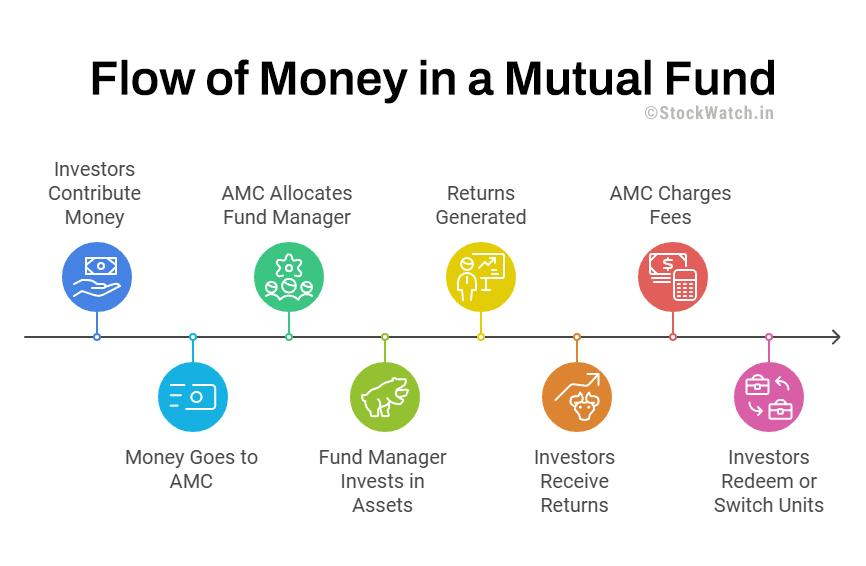
Step 2: The Asset Management Company steps in
The mutual fund is managed by an Asset Management Company (AMC).
The AMC operates the fund and appoints professionals to manage the investments.
For example, an equity mutual fund may invest the pooled money in shares of companies such as banks, automobile companies, technology companies or pharmaceutical companies.
A debt fund, on the other hand, may invest in bonds and other fixed-income securities.
Step 3: The Fund Manager makes investment decisions
This is where the fund manager comes in.
The fund manager and the investment team study companies, industries, interest rates, economic conditions and market trends before deciding where the fund’s money should be invested.
So when you buy a mutual fund, you are essentially saying:
“I will pool my money with other investors and let professional managers invest it according to the fund’s strategy.”
Step 4: You receive units
You don’t directly own each share purchased by the mutual fund.
Instead, you receive units of the mutual fund.
The number of units you receive depends on the fund’s NAV — Net Asset Value.
For example, if the NAV is ₹50 and you invest ₹10,000:
₹10,000 ÷ ₹50 = 200 units
You own 200 units of that mutual fund.
Step 5: The investments go up or down
Now imagine the mutual fund has invested in 50 different companies.
If those investments rise in value, the overall value of the fund rises.
If the investments fall, the fund’s value falls.
This change is reflected in the fund’s NAV.
If your 200 units were bought at ₹50 and the NAV later becomes ₹60:
200 × ₹60 = ₹12,000
Your ₹10,000 investment has become ₹12,000, before considering applicable costs, taxes and other factors.
But remember: the value can also fall. If the NAV drops to ₹45, your 200 units would be worth ₹9,000.
So who actually owns the shares?
This is an important distinction.
The mutual fund scheme holds the investments. You own units of the scheme.
That is why investing ₹10,000 in a mutual fund does not mean you personally own ₹10,000 worth of shares in each company held by the fund.
And how does the mutual fund earn money?
The AMC generally earns money by charging fees and expenses for managing the fund. These costs are reflected in the fund’s expenses and ultimately affect investor returns.
There are also other parties involved in the ecosystem, including the trustees, custodian and registrar, each performing different functions to keep the fund operating and investor records in order.
What happens when you want your money back?
In an open-ended mutual fund, you can generally submit a redemption request.
The fund calculates the value of your units based on the applicable NAV, after considering relevant rules and charges, if any.
The money is then paid to you according to the scheme’s redemption process.
In one simple chain
You invest money
↓
Money joins the mutual fund pool
↓
AMC manages the scheme
↓
Fund manager invests the money
↓
Investments gain or lose value
↓
NAV changes
↓
Your units become more or less valuable
Bilkul Simply
A mutual fund is essentially many people’s money pooled together and professionally invested according to a specific investment objective.
You don’t have to choose every individual investment yourself. Instead, you buy units in the fund and participate in the performance of the portfolio.
But mutual funds are not guaranteed-return products. The value of your investment can rise or fall depending on the underlying investments.